Miras Engineering Develops Trenchless Structural Rehabilitation Solution for Metro Dead-End Tracks
The station was originally constructed in the 1980s–1990s using the cut-and-cover method involving open pit excavation. The primary load-bearing system was built using precast reinforced concrete elements, complemented by cast-in-place concrete in specific sections. Prolonged exposure to pressurized groundwater, severe ground saturation, and aggressive soil conditions resulted in substantial degradation of the precast wall blocks, roof beams, and ceiling slabs. This necessitated a comprehensive structural rehabilitation of the dead-end track area.
Miras Engineering conducted an in-depth engineering assessment of the site and developed a closed-method rehabilitation project executed entirely without surface excavation:
-
Replacement of degraded precast wall elements;
-
Structural strengthening of existing ceiling beams and slabs utilizing Carbon Fiber Reinforced Polymer (CFRP) composites;
-
Complete restoration of waterproofing membranes, drainage modernization, and engineering utility upgrades;
-
Multi-stage soil permeation grouting around the tunnel perimeter to cut off groundwater flow and stabilize the adjacent soil mass.
Given the confined underground conditions, a custom temporary steel shoring system was engineered to carry and redistribute structural loads safely. In the ventilation chamber and Zone 1, modular sectional steel shoring columns were installed on the existing concrete base, utilizing hydraulic jacks to relieve the precast walls of overhead loads during replacement.
Along shaft sections II–IV (spanning a total length of 207 m), a 69-meter movable heavy-duty steel frame was implemented. Mounted on guide rails over the existing concrete foundation and repositioned across subsequent phases, the system supports the tunnel roof via hydraulic jacks while doubling as a fully accessible scaffolding platform for overhead waterproofing and repair works.
Comprehensive finite element stress-strain analyses confirmed the safety of the methodology, preventing uncontrolled soil displacement above the station and ensuring long-term structural reliability.

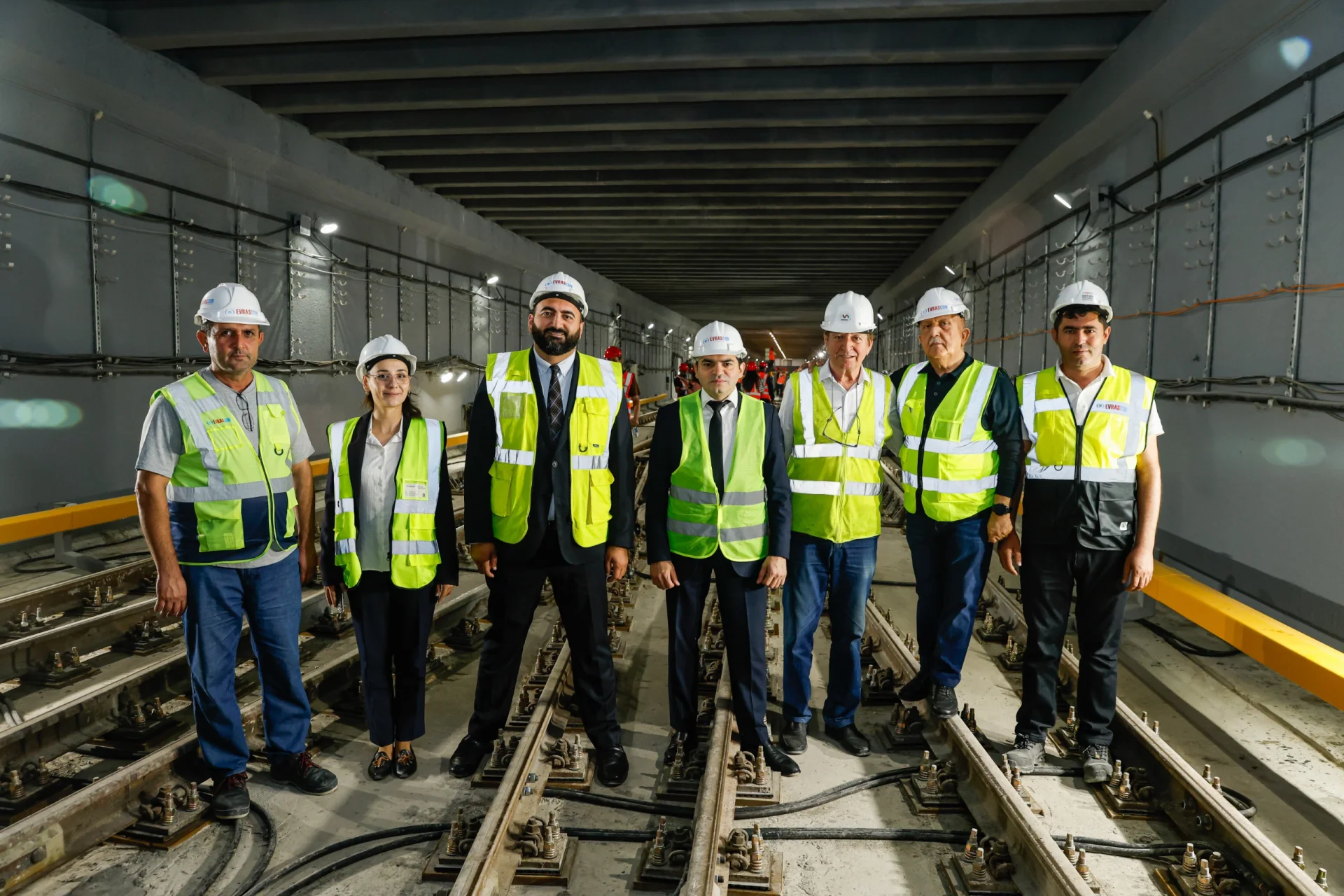
From left to right: Sardar Abbasov (EVRASCON, Site Manager), Sevil Karimova (MIRAS Engineering, Chief Project Engineer), Khagani Asadli (EVRASCON, Project Manager), Azer Nasibov (EVRASCON, Deputy General Director), Can Uzel (Baku Metro, Project Manager), Mahir Gojayev (EVRASCON, Technical Office Manager), Amil Orujov (EVRASCON, Deputy Head of the Occupational Health, Safety and Environment Department).